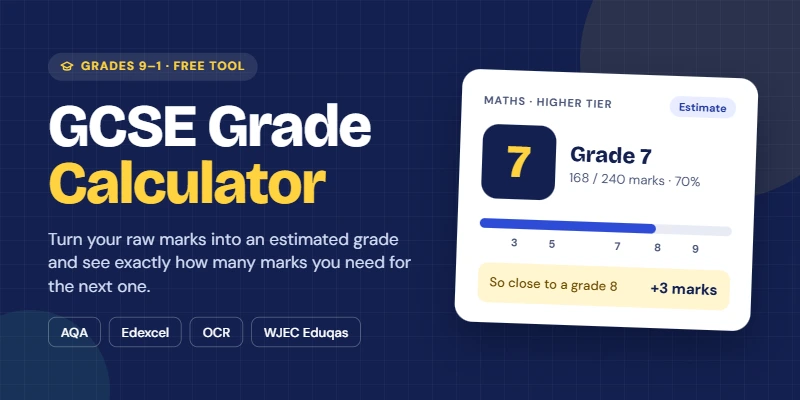
Get your raw marks into an estimated GCSE 9–1 grade in seconds with our free GCSE Grade Calculator, for any subject, exam board and tier. Check if you are close to the next grade level and what marks you need to achieve your grade level.
Must Try: K–12 Grade Calculator
Your exam details
Your estimated grade
Grade boundaries for this exam
Typical estimateHave the official boundaries from your exam board or teacher? Type the minimum mark for each grade into the table and your result updates straight away.
| Grade | Minimum mark | Minimum % | You |
|---|
How GCSE Grades Work
In England, grades 9 to 1 represent the range of achievement in GCSEs; 9 is the best grade and U indicates that the grade was not awarded. The scale has been introduced to replace the former grades of A*-G, and to give a finer gradation of the top grades, allowing the very best students to be distinguished more clearly.
| GCSE Grade | Meaning | Old Letter Grade |
| 9 | Exceptional | Above A* |
| 8 | Excellent | A* / A |
| 7 | Very good | A |
| 6 | Good | B |
| 5 | Strong pass | High C / Low B |
| 4 | Standard pass | C |
| 3 | Below pass | D / E |
| 2 | Low grade | E / F |
| 1 | Very low grade | F / G |
| U | Ungraded | U |
Grade 4 is a standard pass and grade 5 is a strong pass. Grades 7, 8 and 9 roughly match the old A and A* grades.
GCSE Grade Boundaries Explained
Grade boundaries are the lowest raw mark required to achieve each grade in a paper. For instance, if the grade 6 boundary is 112 and the grade 7 boundary is 240, then a student will score a 6 if they achieved a mark of 112 or more, but less than 240.
There aren’t hard lines. They are set by exam boards following the marking of exams (e.g. AQA, Pearson Edexcel, OCR and WJEC Eduqas). They consider:
- Paper difficulty: in a harder paper, the boundaries are likely to be lower.
- National performance: the performance of students nationally.
- Previous year’s results: so that a grade is equivalent each year.
This is why a score can result in different grades in different years. Grade boundaries are released by the exam boards on their websites on results day.
Foundation and Higher Tier (GCSE Grade Calculator)
Tiered means that some subjects are differentiated into Tiers, such as Maths, sciences and modern foreign languages:
- Foundation tier (grades 1 to 5). The highest grade possible is a 5.
- Higher tier: grades 4 – 9. For students who just fall short of a grade 4, a grade 3 may be given. This is followed by a U below.
Important Notes
Estimated results are based on typical grade boundaries from previous years, not the official grade boundaries for your specific paper. Grade boundaries are variable so please be sure to refer to the official grade boundaries on your exam board’s website after the release of results every year.
Schools have the freedom to set their own boundaries for exams so, check with your teacher to discover if there are any differences from the exam boundaries used in the mock exams and enter them into the calculator’s boundary table. Further, some subjects have coursework and/or non-exam assessment tasks (NEA) that are assessed in addition to your examination marks to be awarded the final grade. Lastly, exam boards announce grade boundaries where grades are given as whole raw marks, so even one mark short of the required grade can lead to the lower grade.
GCSE Percentage Calculator
To calculate your percentage mark in a GCSE, work out the fraction of marks that you scored and then multiply by 100. For example, 108 out of 160 is (108 ÷ 160) × 100 = 67.5%. Your marks at percentage is very useful to monitor your progress, but GCSE grades are based on raw-mark boundaries and not fixed percentages. There is a possibility that 67.5% may be a grade 7 in one subject and grade 6 in another.
GCSE Marks Calculator
A GCSE is a marks calculator that totals up all the marks in a subject. The majority of GCSEs are made up of two or three papers, for example in Maths, Paper 1, Paper 2 and Paper 3. Each paper’s marks and maximum will be entered separately and the calculator will calculate your overall mark, as will the exam boards.
GCSE Grade Boundaries Calculator
Grade boundaries calculator will display the minimum mark required for each grade on your paper. Converts normal boundary percentages into actual marks for your whole paper. If your exam board/teacher provides official boundaries, enter them into the boundary table and the calculator will provide you with an accurate grade.
GCSE Predicted Grade Calculator
Predicted grades are commonly based on teachers’ expectations from: mock results; classwork and progress over time. A predicted grade calculator will give you an idea of your own: just plug in your latest mock/practice paper marks and see the grade they are worth now. So use a few mocks for a more accurate picture and keep in mind that most pupils tend to grow between the mocks and the real exams.
GCSE Average Grade Calculator
Work out your GCSE average grade by adding together the numeric grades from all of your subjects and dividing by the amount of subjects. For example, grades of 8, 7, 7, 6 and 5 add up to 33, and 33 ÷ 5 = an average of 6.6. But some sixth forms and colleges take a GCSE average to determine entry standards or to forecast A Level results.
GCSE Target Grade Calculator
A target grade calculator is a tool that calculates backwards from a desired grade. Choose your desired grade and the boundary table indicates how many marks you will need and also how many more marks to go from the grade you are on to the one you want. This makes a general aim such as ‘get a 7 in Maths’ more specific, measurable and numerical.
GCSE Combined Science Calculator
Combined Science is a double-GCSE. It receives a ‘double grade’ on a 17-point scale from 9-9 down to 1-1, e.g. 7-7, 7-6 or 6-6. Students take 6 papers (Biology, Chemistry and Physics) and the overall aggregate of these 6 papers is used for the double grade. There is a tiering of Combined Science, Foundation (5-5 to 1-1) and Higher (9-9 to 4-4) with 4-3 as a maximum.
GCSE Maths Grade Calculator
There are 3 papers in the GCSE Maths: 1 non-calculator, 2 calculator. These are typically 240 marks in total, with each being 80 marks. Maths is tiered; select Foundation (Grades 1-5) or Higher (Grades 4-9). Enter the marks from all three papers to see your estimated grade. On the Higher tier there are sometimes low boundaries set for maths as the papers are set at a level to challenge the strongest candidates.
GCSE English Grade Calculator
The Grade 9-1 in GCSE English Language is a separate qualification to the Grade 9-1 in GCSE English Literature and no one is tiered in either, meaning that ALL students can achieve any grade 9 to 1. There are 2 papers in each subject. Make your mark in both papers to reveal your (potential) mark. GCSE English Language grade 4 or above is one of the most crucial grades with regard to Sixth Form entry in college.
GCSE Physics Grade Calculator
GCSE Physics is made up of two papers and is offered at Foundation and Higher tier. To view your estimated grade, you will need to input both papers’ marks and select your tier. Physics is often subject-dependent with regard to the boundaries, with the extent of difficulty in the calculation and required-practical questions setting the boundaries that year.
GCSE Chemistry Grade Calculator
There are two papers for GCSE Chemistry, Foundation and Higher. Use marks from Paper 1 and Paper 2, and your tier to work out what grade you are likely to get. Practicing the long six-mark questions and required practical is the best way of achieving marks for the next grade boundary.
GCSE Biology Grade Calculator
There are also two tiered GCSE Biology papers. Enter marks and choose Foundation or Higher to see your estimated grade and what you need to do to progress. There are lots of recall and extended response questions in biology papers and by constantly revising key processes you can cross a boundary in no time.
GCSE Pass Calculator
A GCSE pass calculator will help you to see if your marks are good enough to pass. Grade 4 will be a ‘standard pass’ and grade 5 will be a ‘strong pass’. The calculator is designed to indicate the number of marks required to achieve a grade 4 or above if you are NOT at grade 4. This will be most important for English and Maths: if students do not achieve a grade 4 or above it is likely that they will carry on studying these subjects after age 16.
GCSE Mock Exam Grade Calculator
The best predictor of performance prior to the actual exams are mock exams. Put in your mock marks and check out your predicted grade, then use the table of boundaries to see how many marks you will require to achieve your desired grade. If you have been provided with your school’s own mock boundaries, enter them for more accurate results. After every mock, repeat the calculation to see if you are progressing.
FAQs
What is a passing grade in GCSE?
A grade of 4 is a “standard pass” and will be acceptable in many college courses. A grade 5 is considered a “strong pass” and it will often be necessary for more competitive courses or sixth forms.
What’s the difference between Foundation and Higher tier?
The Foundation tier papers can be marked between 1 & 5, the Higher tier papers can be marked between 4 & 9. A grade 3 may be awarded in the Higher tier if you fail to make a single mark for a 4. The highest grade possible is 5, if you are taking Foundation.
What grade do I need for university?
The requirements are different for each course and university. The majority of competitive courses at the leading universities will require A*AA or AAA at A-Level. Many courses require grades in the range of ABC to BBB or its UCAS equivalent. Most universities will also require a minimum grade of 4 or 5 in GCSE English and Maths.
How is the A* grade determined?
In the majority of the current A-level courses, an A* grade is given if you get a good mark in each of the papers you complete at the end of the course. Additional conditions are added for some subjects. For instance in the A-Level Mathematics and Further Mathematics the A* is only dependent on attainment on specific aspects of the course. The previous modular A-Levels (not the current modular A-Levels) were based on the old rule of an overall grade A plus 90% for the A2 units.
How accurate is this calculator?
The cut-off points for each grade level in this calculator are based on the average boundaries from past years. The actual boundaries are subject to change annually, and should be considered an approximation. The boundaries for mock exams may be different to your school. Use them in the boundary table to get a more precise result.
Why do grade boundaries change each year?
Exam boards set boundaries to ensure consistency of standards. In years where an exam is more difficult than usual, this will be adjusted and boundaries will be lowered, so that a grade will indicate the same level of achievement as in other years. This way, it doesn’t matter which year it’s in.
How do you calculate a GCSE average grade or point score?
In the 9–1 system the grade is based on the point score, and a 7 would be 7 points. A point grade is the average of the point values of your grades in the subjects, so grades of 6, 5, 7, 4 and 8 average to 6.0. Subjects are double weighted for English and maths, and only certain subjects included in school performance measures (Attainment 8). The average for each school will not be the same as a simple average of your grades.
Can it predict the grades I will actually get?
It gives you the idea of the marks you will be getting against the usual boundaries which are not the same in the summer. Think of the result as a snapshot of where you are, not a prediction and repeat after each set of mocks.
Conclusion
Use a GCSE grade calculator to make sure you know where you’re at. Transfers raw marks to an estimated grade, indicates your proximity to the next grade and you will know exactly how many marks you will need to achieve your desired score. Grade boundaries vary from year to year, so you should interpret each result as a provisional grade and verify the boundaries upon publication of the results. It is an easy to use tool after the mock and practice papers to identify realistic targets, prioritize revision and head into exams with confidence.