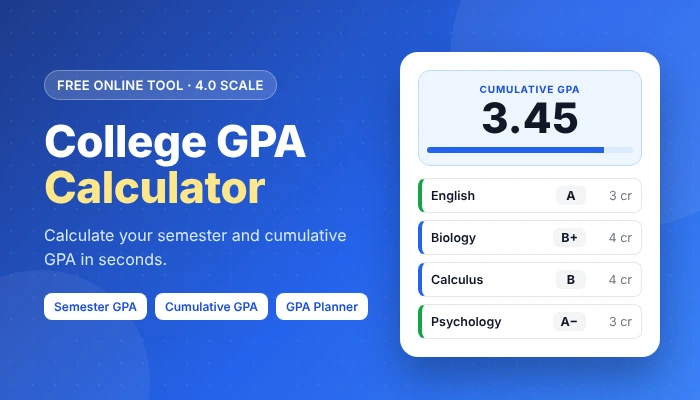
Find your college GPA with this free Collage GPA Calculator! Just insert your letter grades and amount of credits and the calculator calculates the math on a standard 4.0 scale. You can also enter your cumulative GPA, monitor the cumulative GPA, and calculate what grades you need to post a desired GPA. Here is a quick overview of the GPA system in college, how to figure it out without using a calculator and what a good GPA is.
Must check: High School GPA Calculator
What is a college GPA?
The GPA (grade point average) is a single number that is a summary of your college grades. The letter grades are converted to grade points, typically on a 4.0 scale, with an A equated to 4.0 and an F equated to 0.0. College GPA is weighted by credit hours. A 4 credit class will have a greater impact on your grade point average than a 1 credit class. This is the only difference between a simple average and this.
There are two different kinds of college GPAs:
Semester GPA (term GPA): Average of grades for one semester or one quarter.
Cumulative GPA: average from all of the terms you have taken. This is the number that will appear on your transcript, and the one that is likely to be requested by employment agencies, graduate schools and scholarship programs.
Some students also compute a major GPA, which is the GPA of the classes in their major.
How to use the Collage GPA Calculator
The calculator takes about a minute to use:
1. Check the grading scale.
The default course rating is 4.0. If your school uses another scale, or provides A+ = 4.33, click on Options and choose the appropriate scale.
2. Enter your classes.
Select your letter grade and number of credits for each class. Course name is optional.
3. Add more classes or semesters.
We can add more rows for + Add class or + Add semester for another term.
4. Add your previous GPA (optional).
On the Open Options, click on Add previous GPA and input your cumulative GPA and GPA hours from your transcript.
5. Read your results.
You can see your cumulative GPA, total credits, classes and quality points update immediately. A GPA is also provided for each semester.
Plan ahead (optional).
To see what the average grade you need, enter a desired GPA and next term’s credits in the GPA planner.
Other helpful features:
- Major GPA: enable it in Options and then make sure that it is checked when you click Edit on a class; you will see Major class.
- Planned courses: if you have planned courses, click on edit and check the box for planned course to see your GPA “what if” you get those grades.
- Repeat Grade: select it from the grade list to replace an old grade with a new one.
- Biggest lever: reflects the single grade change that would have the most impact on GPA.
Your entries save automatically on your device, so you can come back later.
How to calculate college GPA
You can calculate your college gpa calculator with credits by hand in three steps:
- Convert each grade to grade points using the scale below (for example, B+ = 3.3).
- Find the quality points for each class by multiplying its grade points by its credits.
- Divide the total quality points by the total credits.
GPA = Total (grade points × credits) ÷ Total credits
For example, 48.3 quality points ÷ 14 credits = 3.45 GPA.
Example: semester GPA
| Class | Grade | Grade points | Credits | Quality points |
| English Composition | A | 4.0 | 3 | 12.0 |
| Biology | B+ | 3.3 | 4 | 13.2 |
| Calculus | B | 3.0 | 4 | 12.0 |
| Psychology | A− | 3.7 | 3 | 11.1 |
| Total | 14 | 48.3 |
Semester GPA = 48.3 ÷ 14 = 3.45.
The average of the four grade points would be 3.50. No, that is incorrect since it does not take into account that Biology and Calculus have more credits.
Example: cumulative GPA
Suppose that your next semester is 15 credits and 42.0 quality points (GPA of 2.80). Sum the numbers from both terms:
Cumulative GPA = (48.3 + 42.0) ÷ (14 + 15) = 90.3 ÷ 29 = 3.11.
Don’t average your semester GPAs ((3.45 + 2.80) ÷ 2 = 3.13). Quality points and credits always must be added together; bigger terms count more.
How to calculate GPA on the quarter system
The math used for the quarter system is the same: multiply grade points by units, then add the results and divide by the total units. Simply enter each of the three terms (Fall, Winter, Spring) as separate terms in the calculator with the quarter units as the credits.
It is only necessary to convert units when using both quarter and semester credits, such as when transferring between schools. First convert into quarter units because they are of smaller size:
Semester credits = Quarter units × 2/3
For example, 45 quarter units × 2/3 = 30 semester credits.
In this case, 45 quarter units with a 3.20 GPA is equivalent to 30 semester credits (45 x 2/3). That as a prior 3.20 GPA with 30 GPA hours.
When you convert, the GPA remains the same. The weight of the credits matters and that’s it, quarter classes don’t count more than they’re supposed to.
What is a good college GPA?
A 3.0 or higher (a B average) is generally considered a good college GPA, and 3.5 or higher is considered very strong. However, “good” is dependent upon the goal, so always take the time to verify the actual goal you are working towards.
| GPA range | Letter average | What it usually means |
| 3.7 – 4.0 | A− to A | Excellent. Competitive for top graduate programs, honors, and scholarships. |
| 3.3 – 3.69 | B+ to A− | Very good. Often meets Dean’s List and many scholarship cutoffs. |
| 3.0 – 3.29 | B to B+ | Good. Meets the common 3.0 minimum for many jobs and graduate schools. |
| 2.0 – 2.99 | C to B− | Satisfactory. Usually in good standing, but some programs may be out of reach. |
| Below 2.0 | Below C | At risk. Many colleges place students on academic probation below 2.0. |
Things to keep in mind:
Which classes count toward college GPA?
Only classes that earn a letter grade (A to F) count toward your GPA. Other grades may still give you credits toward graduation, but they don’t change your GPA.
| Grade or class type | Counts toward GPA? | Notes |
| Letter grades (A to F) | Yes | An F counts as 0.0 points and can pull your GPA down a lot. |
| Pass (P) | No | You earn the credits, but no grade points. |
| No Pass (NP) | No | No credits and no grade points at most schools. |
| Withdrawal (W) | No | Shows on your transcript but does not affect GPA. |
| Incomplete (I) | Not yet | Counts once a final grade is given. Some schools turn it into an F after a deadline. |
| Repeated course | Depends | Some schools use the newest or highest grade; others count every attempt. |
| Transfer credits | Usually no | Often count toward your degree but not your school GPA. |
| AP / IB credit | Usually no | Typically gives credit only, with no grade points. |
Each college has its own rules so look in your college catalog or query your college registrar’s office. The calculator automatically excludes P, NP and W and Repeat Grade allows to update an existing grade with a new one. Also, there are differences in rounding, with the majority of schools rounding to two decimals, while some cut off (truncate) the extra digits. These can be swapped out in Options.
College GPA scale: letter grades to grade points
Most U.S. colleges use this standard 4.0 scale. The percentage ranges are typical, but your instructor or school may use slightly different cutoffs.
| Letter grade | Percentage | Grade points (4.0 scale) | With A+ = 4.33 |
| A+ | 97–100% | 4.0 | 4.33 |
| A | 93–96% | 4.0 | 4.0 |
| A− | 90–92% | 3.7 | 3.67 |
| B+ | 87–89% | 3.3 | 3.33 |
| B | 83–86% | 3.0 | 3.0 |
| B− | 80–82% | 2.7 | 2.67 |
| C+ | 77–79% | 2.3 | 2.33 |
| C | 73–76% | 2.0 | 2.0 |
| C− | 70–72% | 1.7 | 1.67 |
| D+ | 67–69% | 1.3 | 1.33 |
| D | 63–66% | 1.0 | 1.0 |
| D− | 60–62% | 0.7 | 0.67 |
| F | Below 60% | 0.0 | 0.0 |
A few colleges assign a 4.33 grade to A+ and some assign different values to minus and plus grades. If your school’s scale is different, choose Custom values in the calculator’s Options and type in your school’s numbers.
Frequently asked questions
Is a 3.0 GPA good in college?
Yes. A 3.0 is a respectable B grade, and is a grade that many employers and graduate programs require for employment.
How do I raise my college GPA quickly?
Prioritize high credit courses as they will be weighted the highest. If your school uses a different grade for the same course that you failed, retaking a failed class can benefit you as well. The calculator’s biggest lever indicates which grade change is most helpful.
Does a W (withdrawal) hurt my GPA?
No. There is no impact on GPA for a W, but this may have an impact on financial aid and academic progress if too many withdrawals are received.
What’s the difference between semester and cumulative GPA?
One term’s worth of Semester GPA. Cumulative GPA is the total of all your terms, with credits accounted for.
Can my GPA go above 4.0 in college?
Usually not. Most Colleges will only accept grades to a maximum of 4.0, however schools that allow A+ = 4.33 can achieve a GPA of a little higher than 4.0.
How many credits do I need to raise my GPA?
It is dependent on the number of credits you have. To see exactly what average you need to reach this term, enter your target in the GPA planner.
How do I use the college GPA calculator with my current GPA?
In Options, set the Add previous GPA to Yes then enter your current GPA, GPA hours, and this semester’s grades. You will instantly see your new cumulative GPA in the calculator.
how to calculate cumulative gpa for all semesters
Total the quality points (grade points × credits) earned during all semesters and divide by the total number of credits earned during all semesters.
Example: (48.3 + 42.0) ÷ (14 + 15) = 3.11. Please don’t take a median of your GPAs in each semester.