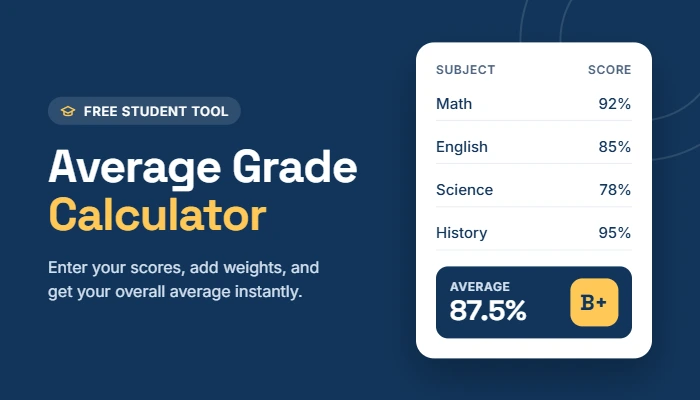
This free and easy-to-use average grade calculator can help you quickly get your average grade. Input every assignment, test or course score or percentage, optionally add weight/credit hours, and calculate your overall average in a flash. It can be helpful for students who would like to see how much progress they are making, who need to know what score they need on a test/assessment in the future, or who want to find out how they are doing before report cards are issued. No signs up and no math necessary; simply enter your grades and you’ll see the outcome. You can easily check Average Grade Calculator
Must Check: Grade calculator
Average Grade Calculator
Enter your grades and their weights to find your weighted average instantly.
View grading scale
| Letter | Percentage | GPA |
|---|
Grade average provides information about how you are doing on quizzes, assignments, and tests. You do not consider each score individually, but rather add them together to get a single score.
This calculation can be made easier by using a grade average calculator. Depending on how your teacher records your results, you will be able to work with percentages, letter grades or earned points. It is important to select the method that is appropriate for your course’s grading policy.
What Is a Grade Average, and Why Simple or Unweighted?
The average grade is a number that represents a collection of grade numbers. Simple (Unweighted) Average: All grades entered are used to calculate this average. For instance, if you put 3 percentage scores, then each number will be one-third of the average.
Whether the short quiz was more or less labor intensive than the final exam is not relevant to this method. If all assessments are equally important or you are looking for an overall view of your grades, an unweighted grade average is useful. If your syllabus specifies different percentages for homework, exams, and projects, then you’re going to need a weighted calculation.
How the Grade Average Calculator Works: The Formula
Average grade = (sum of all the grades) / (number of the grades)
For scores of 80, 85, and 90, the average is 255 ÷ 3 = 85%.
How to Calculate Average Grade by Percentage?
Calculate the mean (average) by adding up your percentage scores and then dividing by the number of scores. For example, 85%, 90%, 78%, and 92% produce an average of 86.25%.
How to Use This Calculator
The first step is to select the format suitable for your grade. Write one score on a single line, verify that each score is on the appropriate scale and find the mean (average). Prior to using the result for academic planning, check your selected method against your syllabus. The numbers can be added up correctly by a calculator, but it requires the proper numbers and grading procedure.
Percentage Mode
Enter 80, 90, 85 (and so on) in the percentage scores field. The simple average assigns equal weight to each score.
Letters Mode
Write in letter grades (A, B, and C). These are then converted to numerical values with the chosen grading system.
Points Mode
Write in earned points and also possible points. Your percentage is equal to points earned/total possible points x 100.
Weighted vs Unweighted: Which Do You Need?
Unweighted = All grades are weighted equally. A weighted average assigns more weight to certain assessments. Use a weighted grade calculator for courses with category percentages on your syllabus.
How to Average Letter Grades
Convert Each Letter to Its Point Value
On a basic scale, A = 4, B = 3, C = 2, D = 1, and F = 0.
Add the Points
For A, B, and C, add 4 + 3 + 2 = 9.
Divide by the Number of Grades
Divide 9 by 3 to get 3.0.
Map the Result Back to a Letter
On this scale, 3.0 equals B. Follow your school’s rules for results between letter values.
Percentage, Letter, and GPA Conversion Table
This example scale varies by school.
| Percentage | Letter | Grade points |
| 90–100% | A | 4.0 |
| 80–below 90% | B | 3.0 |
| 70–below 80% | C | 2.0 |
| 60–below 70% | D | 1.0 |
| Below 60% | F | 0.0 |
Dropping the Lowest Grade
If your syllabus allows it, remove the lowest eligible score before averaging. For 60, 80, and 90, dropping 60 changes the average from 76.67% to 85%.
Worked Examples
| Method | Example | Average |
| Percentages | (80 + 90) ÷ 2 | 85% |
| Letters | (A + B + C) using 4, 3, 2 | 3.0 / B |
| Total points | 45 ÷ 60 × 100 | 75% |
For Teachers: Averaging a Class
Add comparable student scores and divide by the number of students. Scores of 90, 95, 100, and 80 give a class average of 91.25%.
What Grade Do I Need? What-If Planning
For equally weighted assessments:
Required score = Target average × Total assessment count − Existing score total
If your first two scores are 80 and 90, you need 94 on the third to average 88.
Common Mistakes to Avoid
- The most common error is to calculate the simple average of a weighted course. Look at the grading breakdown, before doing the calculations.
- Another error is combining raw with percentages. The score of 15 out of 20 does not mean 15% – it means 75%.
- Don’t forget to pay attention to missing grades either. An assessment without a value will not count towards the average, and a value of zero will count as failing. Implement the teacher’s policy.
- Last but not least, don’t round each score before taking the average. Round to the required number of decimal places during calculation and round the answer at the end as per school policy.
Related Calculators
Various academic questions require various tools. Category percentages are handled by a weighted grade calculator and a final grade calculator can make an estimate of what you need on an upcoming exam.
The GPA calculator will add together the course grades based on the required grade-point scale, along with, if applicable, credit hours. A test grade calculator is a tool that is used to calculate the percentage of the correct answers or earned marks on a test.
Select the calculator most appropriate to the data you have and the answer you are looking for.
Frequently Asked Questions
How Do I Calculate My Grade Average?
Sum all the scores and divide by the number of scores (assuming they all are equal).
Do All Grades Count Equally in a Simple Average?
Yes. Each entered grade has the same influence.
How Do I Average Letter Grades?
Convert letters to points, calculate their average, and convert the result using your grading scale.
What Is the Difference Between a Weighted and an Unweighted Average?
Weighted averages assign different importance to scores. Unweighted averages treat them equally.
Is My GPA the Same as My Grade Average?
No. A grade average usually combines assessment scores, while GPA combines course grades on a grade-point scale.
Can I Include Extra Credit in My Average?
Yes, but apply it exactly as your teacher does, whether as bonus points or a grade adjustment.
How Do I Drop the Lowest Grade?
Subtract the lowest eligible grade and average the remaining grades (as outlined in your syllabus).
Can Teachers Use This to Find a Class Average?
Yes. Record one similar score for each student and find the mean.