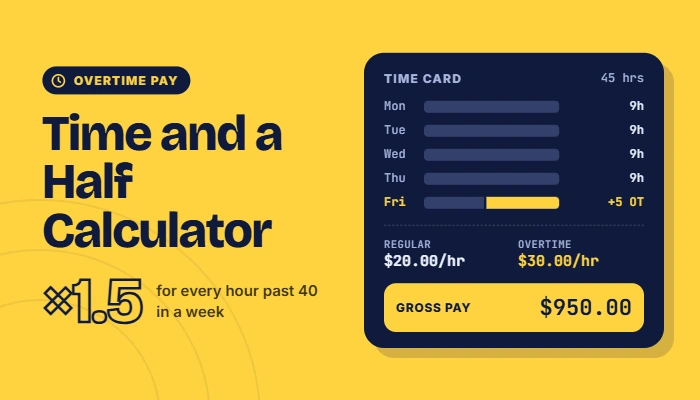
Time And Half Calculator is given bellow
Time and a Half Calculator
Enter your hourly rate and hours to see your time-and-a-half rate, overtime pay and total gross pay.
Only know your total hours for the week? Split them automatically at 40 hours (US federal overtime rule).
| Type | Hours | Rate | Pay |
|---|---|---|---|
| Regular (1×) | 0 | $0.00 | $0.00 |
| Overtime (1.5×) | 0 | $0.00 | $0.00 |
| Double time (2×) | 0 | $0.00 | $0.00 |
| Total | 0 | $0.00 |
Gross pay before taxes and deductions. Under US federal law (FLSA), non-exempt employees earn at least 1.5× their regular rate for hours over 40 in a workweek. Some states and employers have extra rules, such as daily overtime or double time.
Must read: Credit Hour Calculator
How Time and a Half Is Calculated
Time and a half implies that for overtime, you will receive 1.5 times your regular hourly pay. To find your overtime rate, multiply your hourly rate by 1.5. Then multiply that rate by your overtime hours to get your overtime pay. Employer’s Gross pay for the period is your regular pay and overtime pay combined.
Common Time and a Half Rates
| Regular rate | Time and a half | 5 overtime hours earns |
| $15.00 | $22.50 | $112.50 |
| $18.00 | $27.00 | $135.00 |
| $20.00 | $30.00 | $150.00 |
| $25.00 | $37.50 | $187.50 |
| $30.00 | $45.00 | $225.00 |
When Does Time and a Half Apply?
Overtime is based on different factors such as hours worked, location of work and job classification. The federal law establishes a minimum standard, with some states providing additional protection.
Over 40 hours in a workweek (federal)
Under the Fair Labor Standards Act (FLSA), non-exempt workers are entitled to receive one and a half hours of pay for each hour that they work over 40 in a particular week. The workweek is defined as a day-to-day series of 168 hours and starts on any day of the week by your employer’s discretion.
Daily overtime (some states)
Some states also work overtime on a daily basis. In California, time is paid at 1½ times after 8 hours in any workday and double time after 12 hours. Overtime: Alaska and Nevada use 8 hours, Colorado uses 12 hours.Daily Overtime limits are after the 8th hour for many workers in Alaska and Nevada, and after 12 hours in Colorado. Look in your state labor department for specific rules in your area.
Holidays and weekends — usually not required
According to many, overtime is a right for workers who work on holidays or weekends, but this is not the case under federal law. Additional holiday pay is provided by company policy or a union agreement. The exception is if those hours bring you over 40 hours for the week, then overtime still kicks in as normal.
How to use our time and a half calculator
Enter your wage rate and then your regular hours and overtime hours. If you are only given the total hours worked for a week, then you can enter the total hours in the split box and press “Split at 40 hours” and the calculator will split the hours for you. If you get paid for double time hours, add them. Overtime rate, overtime pay and total gross pay are instantly displayed.
What is overtime pay?
Overtime pay is the extra pay you earn for hours beyond your standard schedule. In the United States it usually means time and a half for hours over 40 per week, paid to employees who are not exempt from the FLSA.
How do I calculate my overtime pay?
Multiply your hourly rate by 1.5, then multiply the result by your overtime hours. At $22 an hour, your overtime rate is $33, so 6 overtime hours earns $198.
What is double-time pay?
Double-time pay is twice your regular hourly rate. Federal law doesn’t require it, but some states, such as California, do in certain situations, and some employers offer it for holidays or long shifts.
Is overtime pay a federal mandate in the United States?
Yes. The FLSA requires overtime for non-exempt employees who work more than 40 hours in a workweek. Exempt employees, such as many salaried managers and professionals, aren’t covered by this rule.
How do I calculate time and a half plus my standard salary?
Calculate regular wages for regular work hours then overtime wages on overtime hours and total the two amounts. For example, 40 hours at $20 is $800, 5 overtime hours at $30 is $150, and your total gross pay is $950.
What is holiday policy like in the US private sector?
Private employers aren’t legally required to give paid holidays or holiday premium pay. Most offer some paid holidays as a benefit, and some pay time and a half or double time for working them, but the details vary from company to company.
Who Is Eligible for Time and a Half Pay?
Most hourly workers are eligible, along with salaried employees who earn below the federal salary threshold and don’t fall into an exempt category. Executive, administrative and professional roles that meet specific duties and salary tests are usually exempt. Independent contractors aren’t covered by overtime law.
Special Considerations: Holiday Pay and Unusual Shifts
Night shifts, split shifts and on-call time can all affect your pay. Time you’re required to spend on call at the workplace generally counts as hours worked. Shift differentials and many bonuses must be included in your regular rate before overtime is calculated, which can raise your true overtime rate
Avoiding Common Mistakes in Overtime Calculations
The most common mistakes are averaging hours across two weeks instead of counting each workweek separately, leaving bonuses out of the regular rate, and rounding hours in the employer’s favor. Comp time in place of overtime pay is generally not allowed for private-sector employees. Track your hours carefully and compare them with each paycheck.
Frequently Asked Questions
What is time and a half for $20 an hour?
Time and a half for $20 an hour is $30 an hour, because $20 × 1.5 = $30. You get an additional $150 for working 5 hours overtime, in addition to your regular salary.
When is time and a half required?
Non-exempt employees who work more than 40 hours per week must be paid time and one-half.If an employee is working more than 40 hours per week, he or she must be paid time and a half unless the individual is exempt from the overtime provisions of federal law. Some states go even a step further. California, for instance, also mandates it after 8 hours in 1 day and 2 after 12 hours.
Do employers have to pay time and a half on holidays?
It is not required by Federal law. Holiday premium pay is a concession provided by the company or union in a contract. Overtime is only to be applied on those days if total hours worked in a week exceed 40 hours.
How do I calculate time and a half for salaried employees?
To determine your hourly rate, take your weekly salary and divide it by the number of hours it is supposed to cover (40). Add 1.5 to the overtime hours. Overtime is a right only for non-exempt employees who are paid for on a salary basis.
What is the difference between time and a half and double time?
Time and a half: 1.5 times your regular pay rate; double time: 2 times. The federal law only calls for time and a half. Double time applies only in limited situations (such as California for hours worked in excess of 12 per day) or when offered by the employer.