Each college course you enroll in has a number that subconsciously affects all your future academic lives: its credit hours. Those numbers determine your GPA, whether you are taking full-time classes, the amount of tuition you pay, and when you graduate. Our Credit Hour Calculator is free and will give you the answers you need to your courses, grades and credits in seconds so you always know your position.
Must Read: Attendance Calculator
Credit Hours Calculator
Enter your courses and their credit hours to see your total for the semester.
Full-time is usually 12 or more credit hours per semester for undergraduates. Check your school’s rules.
What Is a Credit Hours Calculator?
A credit hours calculator is a website that can be used to add up the number of credits for each course in your program and then help you to calculate your grade point average. You can enter each course grade and credit value, while the calculator does the math for you – replacing the need to manage grade scales, multiply, and divide on paper. Processes 2 tasks concurrently. It adds up your credits for a semester or for your entire degree, and then assigns a weight to your grades based on those credits: that’s what colleges do to determine your official GPA. So you will have a true reflection of your workload and academic achievement.
How GPA Is Calculated
Your GPA is not an average of your grades. It is a weighted average and therefore offers a higher weighting to courses with more credit hours. A grade for a 4 credit science course is more significant than a grade for a 1 credit seminar.
The formula is:
GPA = Total quality points ÷ Total credit hours
Most US schools use the 4.0 scale:
| Letter grade | Grade points |
| A / A+ | 4.0 |
| A− | 3.7 |
| B+ | 3.3 |
| B | 3.0 |
| B− | 2.7 |
| C+ | 2.3 |
| C | 2.0 |
| C− | 1.7 |
| D+ | 1.3 |
| D | 1.0 |
| F | 0.0 |
Steps to Use This Credit Hours Calculator
The Calculator has been designed to be quick and easy. Follow this easy method to obtain accurate results in less than a minute.
Step 1, add a Semester.
To begin, set up a semester, e.g., “Fall 2026”. Courses by term ensures that one can see the results and how each semester contributes to their total GPA.
Step 2: Add Course Details
Enter a course name (optional), letter grade (optional) and course hours (required) for each course. Credit values will be listed in your course catalog, syllabus or student portal.
Step 3: Add Additional Courses
Add each class that you are enrolled in for that term by clicking “+ Add course”. Add labs, electives and one-credit seminars; all credit will be counted towards totals.
Step 4: To add Multiple Semesters, follow the steps below.
Looking to get your cumulative GPA? Include each past semester along with its courses. The calculator adds all the terms together, giving each course its assigned credit value to provide accuracy in the overall result.
Step 5: Calculate Results
Results are automatically updated as you type: total credit hours, quality points, total S-GPA and total C-GPA. No complicated setup and no sign up.
Academic Progress is checked in Step 6.
Review your work. Do you have the grades you need to meet your desired GPA? Have enough credits to be considered a full-time student? Make confident plans for your next semester based on the evidence you see.
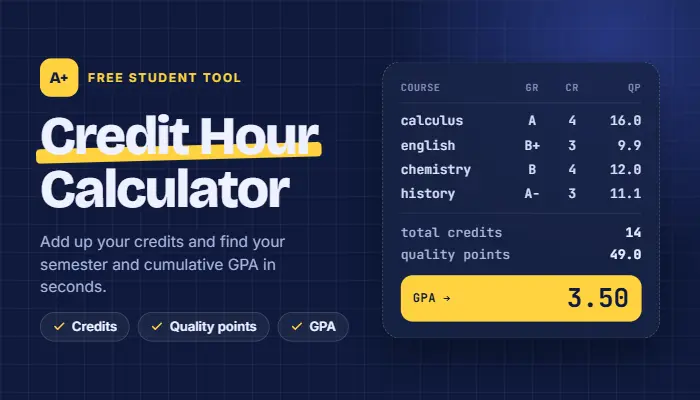
Example 1: Semester GPA Calculation
Let’s calculate the GPA for a student taking four courses in one semester:
| Course | Grade | Grade points | Credits | Quality points |
| Calculus I | A | 4.0 | 4 | 16.0 |
| English Composition | B+ | 3.3 | 3 | 9.9 |
| General Chemistry | B | 3.0 | 4 | 12.0 |
| U.S. History | A− | 3.7 | 3 | 11.1 |
| Total | 14 | 49.0 |
Semester GPA = 49.0 ÷ 14 = 3.50
Quality Points
Quality points are the bridge between your grades and your GPA. To find them, multiply a course’s grade points by its credit hours:
Quality points = Grade points × Credit hours
In the example above, the A in Calculus earns 4.0 × 4 = 16 quality points, while the B+ in English earns 3.3 × 3 = 9.9. Quality points show why credit hours matter so much: a strong grade in a high-credit course lifts your GPA far more than the same grade in a smaller one.
Why Credit Hours Matter
Credit hours are a unit of time that a course requires. Typically, 1 credit hour is worth 1 hour of class time and 2 hours of study outside of class per week for a 15-week semester in most colleges in the United States. A typical three credit course will thus require approximately 9 hours of work per week. Credit hours give meaning to a list of letter grades because they assign a weight to each grade. If they are not taken, a one credit gym class would have the same impact on a GPA as a four credit engineering course.
Why Track Your Credits
If you keep track of your credits while you are in college, rather than at graduation, you’ll be able to identify issues early when they can be addressed. You’ll know if you’re on track for 120 credits needed for most bachelor’s degree programs, whether or not you have completed general education requirements, and the number of semesters you have remaining. Regular monitoring also can make academic advisor meetings more efficient and effective.
How to Use the Credit Hours Calculator
If possible, leave the unofficial transcript open during the process to make sure that each grade and credit matches with that of the school. To get an idea of your end-of-term GPA, insert the grades that you expect in your current courses; then add the final grades when they are available. Review the calculator at the beginning of each semester to review goals and course planning.
Managing Your Credits Better
Plan all of your degree sequentially, semester by semester. Earn approximately 15 credits a term to complete a 120-credit degree in four years. Check with an advisor that each course meets requirements and look into summer/winter courses to make up for or make up for missed courses. If you’re considering dropping a class, find out what it will do to your credit score and status.
How Credits Affect Everything
Credit hours are more than just a transcript:
- Many financial aid and scholarships are available only for full time enrollment, typically 12 or more credits.
- Tuition is often based on a per-credit-hour basis.
- Generally, international students are required to take a full course of study when they are on a student visa.
- Enrollment eligibility may impact health insurance eligibility and home ownership.
- Graduation dates will be dependent upon one’s timely completion of credits.
Knowing your credits means you’re in control of your time, your money and your future. Stay on top of each and every class, semester, and until you’re out of the door by using our Credit Hour Calculator!